The Visibility Trap: Why Posting More Makes Things Worse
By Meli García · Business systems architect · October 20, 2026 · How I use AI
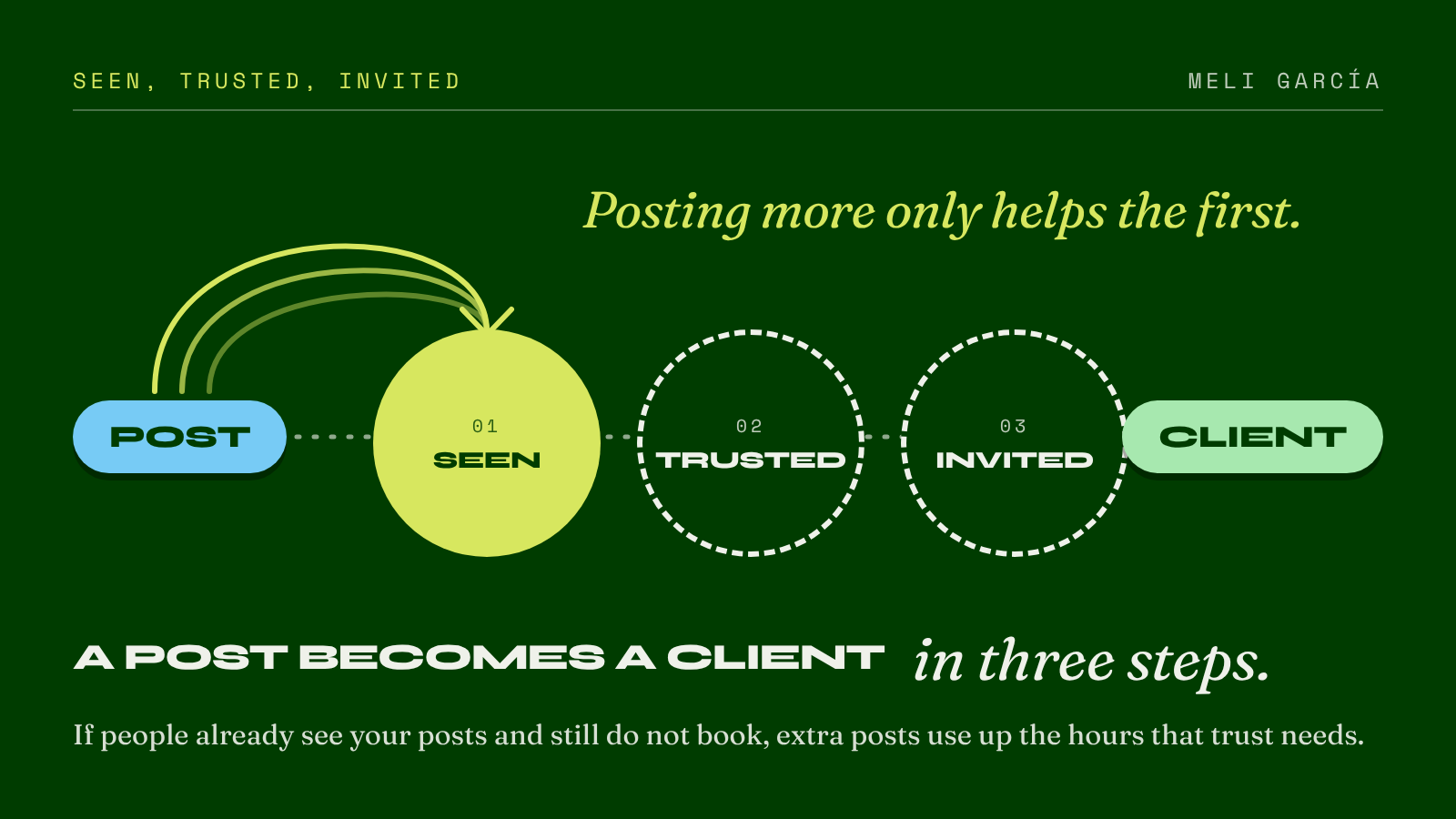
Posting more helps only when the right people cannot find you, and only if your posts are specific to your niche. If they already see your posts and still do not book, extra posts use up the hours that trust needs. A post becomes a client in three steps: seen, trusted, invited. Find the missing step, then spend one week on borrowed audiences and direct conversations before you make posting your main activity or expect major results from it.
Two people host evening events at the same independent bookshop. One of them fills the room every time she runs one. Nobody booked the other one’s last evening, and the other one is my client.
She had been posting about it. When we looked at who had come to her earlier evenings, almost every name was someone who already knew her, or someone the shop had sent her way. That is not a bad thing. It is how you start, and it is how you get referred. You just have to keep those people engaged, which is what The Referral Cliff is about.
I know the reflex that comes next, because I had it too. A lot of us hide behind content creation, and that is what I did for a while. I was creating in volume, on a lot of my own assumptions and without much strategy, and I was just waiting to go viral. The reality is that social media right now requires a lot of strategy in many areas.
So the point is not simply to post more. You can post more, and most likely you will get some results. What matters is knowing what to post, doing it with the right strategy, talking to the right people and answering their questions.
Why isn’t posting more bringing me clients?
Because a post only does the first of three jobs.
A post turns into a client in three steps, seen, trusted and invited, and posting more only helps the first. I call that Seen, Trusted, Invited.
My buyers ask this in their own words. One question I collected on 17 August 2026 asks why “just stay consistent” fails coaches who are already posting consistently. My answer is yes and no. Are they really being seen, and are they being seen by the people they want to be seen by? That is the key. If they are, consistency only adds more of step one, and their gap sits in step two or three.
People will not find you if your posts are not strategic and specific. Your niche is specific, and at the beginning that means finding what works for you on social media. The algorithm makes this slower. It tests each post, and if people do not respond in the first 30 minutes, it stops showing it. Learning what passes that test takes a while, even for professional content creators, so you need to be dedicated to it.
At the beginning, post for the trust. That is not necessarily how you are going to grow your business. Growth is more likely to come from outreach, and that has been my experience with my own business and with my clients.
There may be more steps than you are counting, too. Are you giving people a reason to give you their email? Are you nurturing that lead after they get your thing? Getting the email is the entire goal of social media.
Posting more makes it worse because posting always feels urgent. You may think many times, “I have not posted in a week, so it must be the thing to do today.” Urgent and important are different things, and it was very hard for me to decide to stop giving content so much of my time. I was spending hours creating it and the results were not following.
I was far from alone. In Orbit Media’s 2026 blogging survey of more than 1,000 content marketers, published 8 September 2026, only 14% reported strong results, the lowest in its thirteen years. Imagine if that is not your profession.
The hours also buy less than they used to. Rival IQ’s 2026 Social Media Industry Benchmark Report, published 5 March 2026, found that the Instagram engagement rate across the brands it tracks fell from 0.36% to 0.30% in a year, a drop of roughly 17%.
Finding the missing step before adding anything is the first move in the Genius Architecture framework, which is diagnosis before building.
Do I have a visibility problem or a foundation problem?
Look at who comes.
If the people who book, buy or reply are only people who already knew you, reach is your gap. If strangers see you and nothing follows, the gap sits after the post, in the foundation under it.
My bookshop client had the first kind, and that was good news. In the first minute after an empty room, I find something positive, so she knows we do not need to change everything. Then we get clinical about the diagnosis.
The positive was easy to find. She has hosted there for many months, the evenings themselves work, and clients have come out of them. She had also looked at the empty list without turning it into a verdict on herself, which is the hard part.
A lot of big artists had to perform to silent rooms, and it is part of the process. You keep showing up, you look at what happened, and you improve a little each time. This is why I call our type of business a spiritual practice: you have to have that faith and keep going before you see it. Faith needs action as well, so you do not stay in the empty room. That is not what I want for you.
Before I tell any coach to post more, I check four things:
- Is her strategy sound?
- Does she have content pillars?
- Is her branding cohesive?
- Are her posts built for attention on that platform, or built for trust?
Then I ask what comes after the post. Is there a next step? Is she mixing her content with nurturing? Is her content giving real value to the kind of client she wants, or is it just grabbing attention from people who want free content?
I find the weakest area and work on that one, because lifting the worst area brings the whole bar up. A quiet feed is one signal among several, and the other signs that show up before a dry month are worth checking beside it.
Why do people see me and still not buy?
Because being seen and being trusted are two different jobs, and most posting advice is written for the first.
Jay Clouse describes the split as attention maximizers and trust maximizers.
A lot of social media sells the blogger-influencer lifestyle. For some people that works, and it suits a different sort of business. My clients work with the deep, personal things a coach or consultant works with, and those things need trust. They are trying to be the first kind, and their work needs the second.
I am a trust maximizer. The people I work with touch very raw, very human things, so trust is the number one thing. Maximizing attention is great if you sell clothes or furniture.
For me, social media is where people see me and think: she exists, I can trust her. My goal is to create content that helps. Going viral would be great if it happened, and I do not plan around it yet.
I have run those strategies for companies I worked with in the past. It is not my focus now, because the return on that investment keeps getting lower. I would not say it is never worth it. It depends on the stage your business is at.
Your content also does a quiet job. Even when people are referred to you, some never contact you, because you have not built trust with them yet. You might not be going viral, and your content may still be speaking to the people who were referred to you, or to someone you reached out to cold. They are going to look for your website and your social presence, and what they find there becomes a trusted source for your reputation.
Trust also travels along closeness. The 2026 Edelman Trust Barometer, which surveyed 33,938 people in 28 countries in late 2025, found that 70% are unwilling or hesitant to trust someone with different values, facts, problem-solving approaches or cultural background. A stranger on a feed starts a long way from you.
It is harder now with all the changes with AI. A Billion Dollar Boy survey of 6,000 consumers, creators and marketers, reported by Creativebrief on 17 October 2025, found that 26% of consumers prefer AI-made creator content, down from 60% in 2023.
Likes can hide this. Many comments come from people who want the free resource, or who want their own name seen under your post.
What does an invitation look like?
It is one specific next step, said out loud, in the place where people already are.
The host who fills the room at that bookshop is in the building most weeks. She tells her regulars about the next evening herself, face to face.
So I asked my client to study her before changing anything of her own. Collect a handful of her promotions. Look at her words, her pictures, her video, and where she makes the invitation.
This is a place where AI earns its keep. It is very good at reading a pile of unstructured examples and finding patterns our eyes would miss. Then you adapt what fits, in a way that is authentic to you and relevant to your audience.
Online, the invitation is a reason to hand over an email address and a follow-up that arrives after it. This is also why scaling visibility before building systems fails. More reach poured onto a page with no next step simply leaks, which is the same pattern behind what to do when warm introductions stop.
Where do borrowed audiences and direct conversations fit?
They come first.
Borrowing an audience means speaking to people someone else has already gathered: a community, a guest session, a podcast. I call that a room, and a room carries all three steps at once.
In one of my recent talks to an online community. People asked about the things they were building, one of them asked where he could follow my writing, and the host asked me to come back. That was seen, trusted and invited in one sitting, and the invitation came from them. A room like that takes thirty minutes to an hour, plus preparation I can recycle for the next room.
A room with great conversations also tells you what content would be useful. Direct conversations do the same job one person at a time.
I run Ally Calls with current clients, past clients and people who considered buying and did not. I am very clear at the start that an Ally Call is research and that nothing is being sold. It is also a seed for the future, and a way for people to refer me even if they will never work with me, because they know what I do.
This is how businesses have worked forever. You understand what people need, and you let them know you are in business, so they can recommend you or come to you later.
Systems still matter here. They make the conversations easier to set up and follow, and getting in the room with people comes first. Then you mine the insights and the data, and find the common patterns.
What should I do this week instead of posting more?
Name your missing step, then give this week’s posting hours to that step.
I would move the effort toward conversations, speaking invitations and the places where your audience already lives.
I cannot give you a blanket statement here, because it depends on where you stand:
- If you post and you notice that clients come from it, that is good. Keep going.
- If your posts send people to your lead magnet or your landing page and they do not convert, the issue is not social media or your posts. The language on that page may not be working.
- If you are at the beginning, give yourself permission to post for reputation, for trust and for data you can learn from. You do not need to wait until it is perfect, or until you have perfect systems and everything automated. The polished version, where one interview a month feeds a whole strategy, can come later and it will matter then. For now it is about engaging the field.
Then work on your missing step:
- If you are not seen. Check that your posts are specific to your niche and answer the questions your people ask. Then ask to borrow one audience: a guest session, a talk, or a class in a community that already has your people in it. Add direct outreach beside it.
- If you are seen and not trusted. Book a handful of Ally Calls and listen for the words people use about their problem. Mine those conversations for patterns. Check that your content nurtures people and gives real value to the client you want.
- If you are trusted and nobody is invited. Write one next step, give people a reason to leave an email, follow up after they do, and say it everywhere you already appear.
I would not tell you to stop posting if you already have systems and a habit of posting. If you need to reduce it, do not fully stop. It is harder to go back, trust me. Just do not make it your priority, and do not hide behind it. If that means stopping for you, then stop.
I know we all have that dream of looking successful, with the coolest carousels and the most engaging reels. That is fantastic, and I have seen social media work. At a company I worked for, I ran social media, and highly qualified leads grew by 18% in the first three months. I got there by analyzing their ideal customer in depth and talking about adjacent topics, like how their technology helped with gaming, which their customers also loved. That sort of growth takes dedication.
If you have not done the outreach, tested your offer and understood your niche better, social media is shooting darts in the dark, based on your assumptions. Do it with low expectations and not as your main channel.
If someone near you sells out, study her first and change one thing. Attention is limited and time is limited, so make every hour you ask for worth it for them.
A few things worth asking.
Start here
If you are not sure which step is missing, the Genius Architecture Scorecard takes five minutes and names the first move.
Name your missing step.
Five minutes, ten questions, and one place to start. The Scorecard shows which part of your business to work on first.
Take the ScorecardTwo quick fields. Then your calendar.
So I know who I am speaking with before we get on the call together.