The Referral Cliff: What to Do When Warm Introductions Stop Coming
By Meli García · Business systems architect · October 13, 2026 · How I use AI

When referrals stop, the cause is usually one of three things. Your past clients stopped hearing from you. The story they tell about you is out of date. Or everyone they know has already heard it. Ask three past clients one question before you add a new channel. Their answers tell you which move comes first.
I asked a client for a referral, and she gave me the name of someone who was already my client. We both laughed, and then I saw what it meant for a business like mine.
For years your clients arrived by word of mouth. Then the introductions went quiet, and you cannot say which month it happened. The usual advice is to add a channel. I would start with a conversation, because the people who used to send you clients already know why they stopped.
Why did my referrals stop when my clients are happy?
Because a happy client and a referring client are two different people.
She refers when four things are true at once:
- she remembers you
- she can say what you do in one sentence
- she knows someone who has not heard it yet
- somebody asked her
I learned the last one myself: this month I made a point of asking my clients for a referral out loud.
Hinge Research Institute studied 523 professional services firms in 2015. It reported that most clients, 69%, are willing to make referrals, and far fewer do. The most common reason, given by 72% of respondents, was that they are never asked about the firms they’ve worked with.
The same study names two more kinds of referral worth building on purpose.
Expertise referrals. If someone knows you specialize in a specific problem, she may recommend you to a person with that problem, even before she knows your reputation. This is what my Ally Calls do. The goal of the call is to leave one more person in the world who knows exactly what I am an expert in, and she may refer me without ever working with me.
Reputation referrals. These run on evidence, so gathering testimonials and showing your own results matters as much as asking.
The study also found that a referral can die after it is made. Buyers ruled out providers who had been referred to them because of an unimpressive website or a quiet online presence, and Hinge’s earlier research showed that over 80% of buyers look at a firm’s website to check them out.
That is why I show up online at all. A year ago I was quiet on social media. Today I am active on LinkedIn and Instagram and I write to my email list, so the person who hears my name finds someone there. The growth itself came from outreach. My email list grew by 10% in two weeks that way, which is why I would put outreach and trust first when you are starting.
An older survey points the same way. Advisor Impact, Charles Schwab and researchers at Texas Tech University asked 1,034 investors about their financial advisors in 2010. Of them, 93% said they were likely to stay, and only 29% had given a referral in the past 12 months.
So how do you move a client from satisfied to engaged? I think this is where incentives come in, together with staying in touch. Here is the process I use:
- Stay present. Check in every three months, follow what she shares, and comment on her wins.
- Give her the words. One sentence that says who you help and with what.
- Ask. Out loud, in its own message.
- Give a reason and a reward. Ask her what would make referring you worth it, and thank her in a way she chose.
Coaching adds a second reason. ActionCOACH wrote in July 2025 about a period with 80% client satisfaction and zero referrals. One client told them she loved the work and could not tell other business owners she needed coaching, because it made her look weak. The more valuable the coaching became, the more their clients wanted to keep it secret.
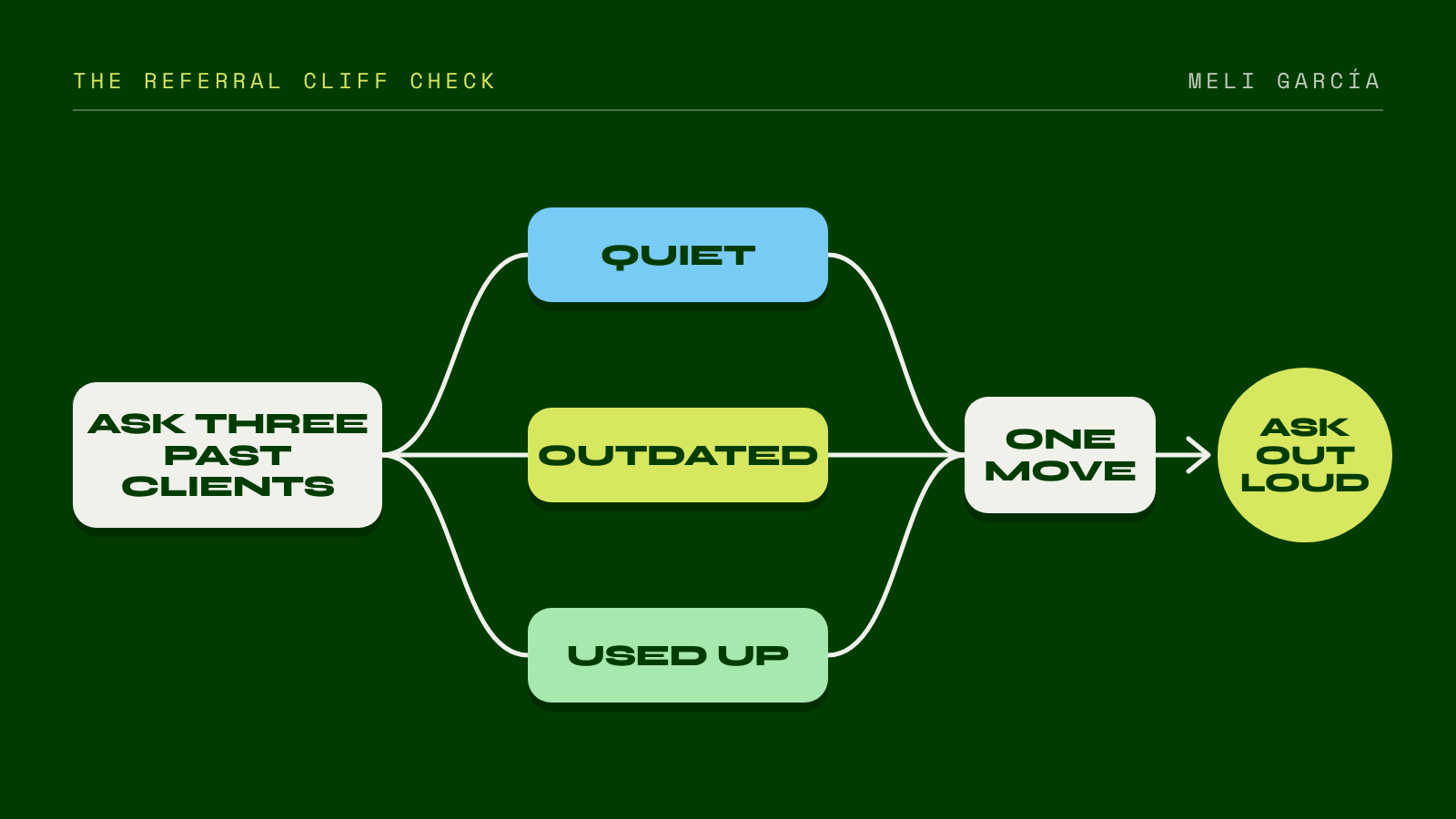
I use The Referral Cliff Check for this. When referrals stop, check whether the cause is quiet, outdated or used up, because each one needs a different first move. It is the first step of the Genius Architecture framework: diagnosis before building.
Did they just stop hearing from me?
Often, yes.
This is the quiet cause: contact faded, you left their minds, and nobody decided anything.
I said this to a room of strangers on 30 September. A lot of us think new leads, new leads, new leads. A lot of our business is in following up with existing clients, and many times asking them: do you have more work for me, or someone you could recommend?
We are sometimes shy to ask. In this era of abundant AI and automation we go back to new leads more and more, and a good, solid business may be sitting right behind us.
Researchers found that the shyness has a shape. Daniel Levin, Jorge Walter and Keith Murnighan asked executives to reconnect with people they had lost touch with, and wrote it up in MIT Sloan Management Review in 2011. Some admitted to simple inertia. Others reported embarrassment about not staying in contact, and others feared coming across as opportunistic. The advice they received was as useful as the advice from their current relationships, and often more useful.
The move for the quiet cause is to reconnect with no ask attached. I am building a system to touch base with past clients every three months: just asking how business is going, or noticing something of theirs and commenting on it. The same system can follow what past clients post, so I can comment on their wins and notice when one of them has gone quiet. Keeping them engaged after they no longer need you is the part worth rewarding.
Is the story they tell about me out of date?
It is if your work moved and their sentence about you stayed where it was.
A past client can only pass on the version of you she met.
A community host I had never met asked me, in the first five minutes of our call, whether I was in marketing or operations. I do both, and a stranger could not tell. If a stranger cannot place me in five minutes, a past client is probably describing an older version of me.
Heather Townsend, who writes about referrals for professional firms, calls this kind of block education friction. She wrote in March 2026: “If your introducer doesn’t understand the need for your services, they are going to find it difficult to make referrals to you.” Haus Advisors said the same about agencies in September 2026: “When former clients can’t describe you in a single sentence to a peer, they don’t refer you.”
The move here is to re-tell. Give three past clients your current sentence and ask them to say it back in their own words. I do this on every call now, not just with clients. I hand people a phrase that describes me in the follow-up email, so they don’t have to find the words themselves. It has gotten me referred more than 20 times.
Every three months I send past clients a version of the same thing: I shifted things a little, I’m focusing on this now, what are you focusing on, and if anyone comes to mind, send them my way. I thank them too, and tell them how working with them inspired the change.
An out-of-date story is one of the quiet signs that come before the cliff.
What if everyone they know is already my client?
Then the circle is used up, and asking harder will not produce a new name.
Your clients know your clients.
That is what my client showed me. She wanted to help, and the one person she thought of was already working with me. Scott Danish, writing at The Coach’s CMO in June 2026, calls this the referral ceiling: “The people who were going to refer you already have.”
The next name comes from outside the circle. In the Hinge study, 81.5% of firms had received a referral from someone who was never a client. Among referrals based on expertise, the top source was “I’ve heard them speak”, at 30%.
I am glad I asked. Sometimes you have to plant the seed. She may not have a name that day, and later she meets someone and remembers that the conversation is open. It is also a reason to keep writing to and nurturing your email list, because each email keeps that conversation open until the day she meets the right person.
What do I do in the first week?
Ask three past clients one question, then match your move to what they say.
The question I would use: when did you last mention me to someone, and what did you say I do?
- “It has been a while” is quiet.
- A description of work you no longer do is outdated.
- “Everyone I know already knows you” is used up.
This is a small version of what I call Ally Calls: structured conversations with current clients, past clients, the people who considered buying and did not, and people in my network, colleagues and adjacent practitioners who could refer me even if they never become clients. AI now helps me read those conversations and understand my ideal client far more precisely than I could by hand. That is what I do on an Ally Call, and you can test one with me.
These calls aren’t only for people just starting out. I’d recommend doing them on a recurring basis at any stage, so your close, medium and wider network keeps hearing what you’re doing and refers you because they know your expertise. A hundred of those conversations, even with people who are only adjacent to the problem you solve, is a hundred people who can place you. On those calls I also ask the incentive question directly: what would make it worth it for you to refer me?
The step most coaches skip is the first half: connecting with the people from before and researching the cause, especially when something isn’t working, or when you’re planning a change or a new offer. I skipped it too, and why outreach came first when I audited my own business is the longer story.
Then one move:
- If it is quiet, reconnect.
- If it is outdated, re-tell.
- If it is used up, reach past the circle with a community or a researched message.
For the used-up case specifically: ask which communities related to their business they’re part of, and whether they can introduce you so you can speak there.
I did the third one this month. My outreach system has run for about three weeks and brought replies, booked calls and two podcast conversations. One host with a large community answered within three minutes, intrigued by how I had found her.
I also spoke in one community. Here is what I think a coach can honestly expect from one talk: probably no client that week. You get a handful of people who can now say what you do, one or two follow-up conversations, a recording you can reuse, and sometimes an invitation back. In my room, one person asked where to follow my writing, and the hosts asked me to return.
How do I ask for a referral without feeling pushy?
Make it its own short message, name who you help, and let her choose the thank-you.
An ask tacked on the end of a call, “let me know if you know anyone”, gives her nothing to work with.
I let each client choose her own thank-you. I offer a few ideas and see what resonates, because I’d rather fit the gesture to her than assume what she needs. I want it to feel significant to her and like a real incentive to do it again.
In my experience, giving people a reason and an incentive to refer works, and timing matters. Kyle Poyar at Growth Unhinged looked at 10.5 million purchases across 4,029 software companies in September 2026. He found that customers are up to 10 times more persuadable in their first 30 days than in months 4 to 11, and that 40% of first-year plan upgrades happen at the month-twelve renewal.
That is software and not coaching, but it matches what I have seen. If you have an upsell, the first 30 days and the renewal are the two best moments to offer it, with a discount that rewards the referral.
What I know from sixteen years in marketing is that one of the main things about sales is asking. If you have never asked once, ask one client this week.
A few things worth asking.
Start here
The reason your referrals stopped is usually sitting in what your clients say to you on calls, and it is easy to lose once the call ends. Session Capture is the free system I gave the room on 30 September, and you install it in ten minutes.
After every client session it gives you back what was decided, what each of you committed to, and the thing she said without noticing she said it, in her own words. And if you would like to see how an Ally Call runs, you can book an Ally Call with me.
Ask one client this week.
Five minutes, ten questions, and one place to start. The Scorecard shows which part of your business to work on first.
Take the ScorecardTwo quick fields. Then your calendar.
So I know who I am speaking with before we get on the call together.