What Should a Solopreneur Build First? Four Questions Set the Order
By Meli García · Business systems architect · November 24, 2026 · How I use AI
Build in the order your own plateau sets. Ask four questions first: where your last three clients came from, what they said made them buy, how many paid hours you worked last week, and what you still do by hand. A strategy plateau needs demand work. A capacity plateau needs delivery work.
Every solopreneur who asks me what to build first already owns most of the answer. She may just have it in the wrong order.
Often she was profitable, and then the number stopped moving. Same hours. Same calendar. The deposits do not grow. So she looks at the long list of systems she could build next, and every one of them looks important.
The order is the part nobody hands her. And the order is a fact about her own business.
Why does every list of systems feel equally urgent?
Because every item on it sounds good. Each one looks easy to automate. Each one promises your clients a smoother experience. So the real question is which one is right for you, right now.
I faced the same list when I built my own systems. I started with market intelligence, because I need inspiration before I can create. Then I put most of my effort into outreach. I believe in real conversations with people more than waiting for a post to go viral. That order fit my business at that stage. Yours may need a different one.
The list keeps growing, too. When I did my Monday review of the accounts in my market recently, four of them were selling AI tools to the same buyer. One sold twenty. One sold thirty. One sold a ten-part vault, and one sold the platform to hold them all. Not one of them said which tool to use first.
In a couple of months, many of those buyers will own a folder of tools and no result. They bought in the order the offers reached them. That is a random order.
Nour at Coachful described the shape of it earlier this year: most coaches and consultants “piece together their own funnels from YouTube videos, courses they’ve half-finished, and strategies they think should work.” That is how the pile forms. Choosing from it is where my method starts.
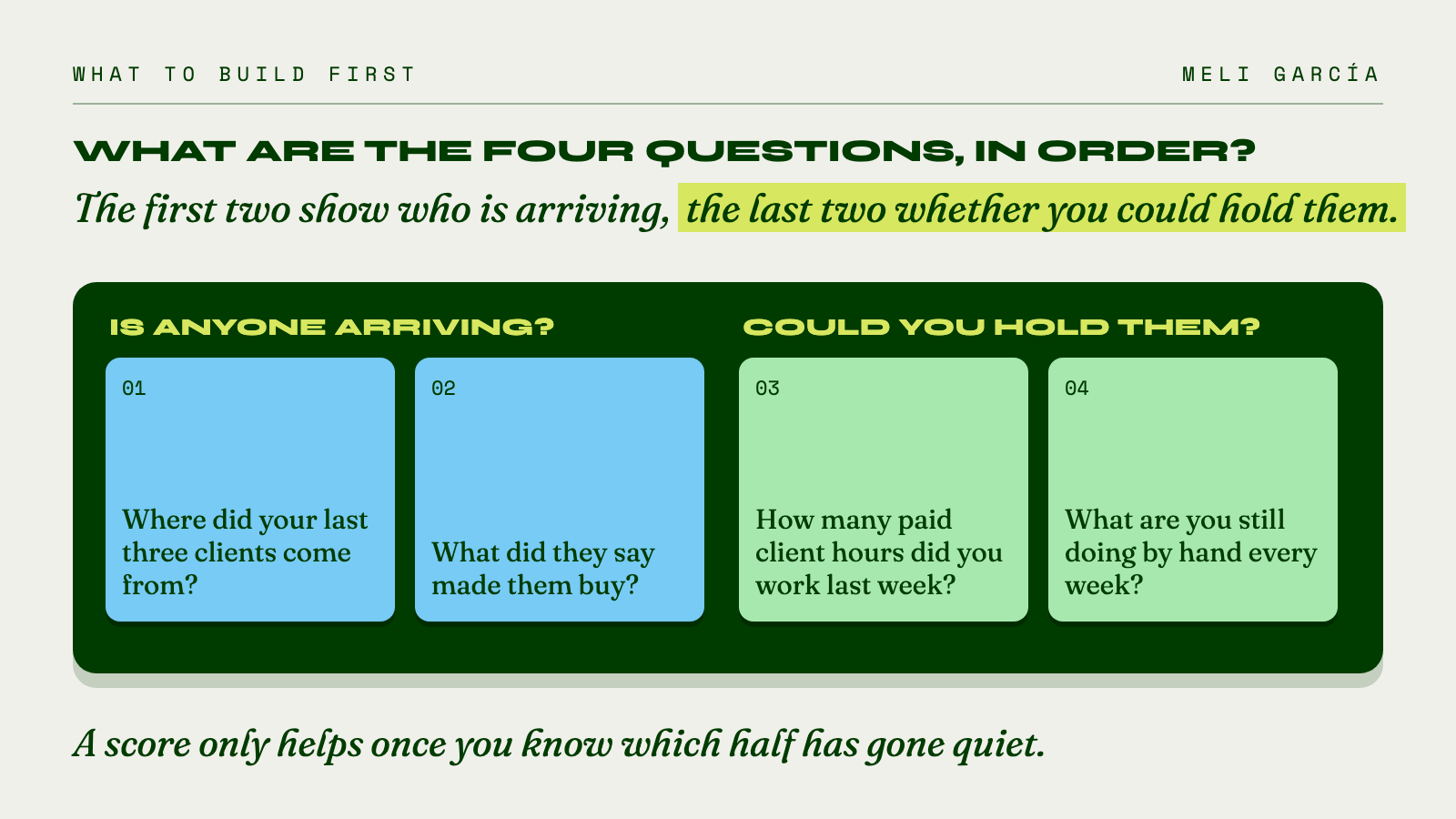
What are the four questions, and in what order?
I ask four questions, always in the same order. An hour is usually enough. The diagnosis hour is four questions asked in order, which name whether a business has a demand problem, a capacity problem or a words problem before anything gets built.
- Where did your last three clients come from? Name the person or the post.
- What did they say made them buy, in their own words?
- How many paid client hours did you work last week? Count them from your calendar.
- What are you still doing by hand every week?
The first two questions show whether anyone is arriving. The last two show whether you could hold them if they did. I ask all four before I score anything, because a score only helps once you know which half of the business has gone quiet. Then I ask one more question: what would you do with five more hours a week? Name the people and the places. That answer tells us what the time is for, and the calls, events and rooms it names are where the next clients come from.
One client answered question three by counting out loud, client by client. Then she asked me to hold the number for her. She had never written it down. The counting took four minutes, and it changed the rest of the session.
How do I tell a strategy plateau from a capacity plateau?
A strategy plateau has room and no arrivals. A capacity plateau has arrivals and no room. A positioning plateau has both, but the words people see do not match what they want to buy.
Here is a story I see often. I will call her Claire.
Claire ran a six-figure business on about 20 hours a week. For years she built it by feel, and it worked. Then it started to grow faster than she could hold. Everything got stuck behind her.
She knew she needed help. She did not know what kind. A content strategist? A marketer? Someone for the back end? Each answer sounded right, and each one would cost money and hours she did not have.
Claire had arrivals. She did not have room. That is a capacity plateau.
Before any hire, we laid every problem out as its own small project. Then we put the projects in order, so the first one was something she could do right away without feeling buried. Her words afterward: it felt "super actionable," and there was "a lot of momentum."
Her first build was the order.
What do I build first at each stage?
One build per plateau. Then you stop. Stopping is the step most people skip.
Recently a client brought me two ceilings in one week. One was her one-on-one roster, which was almost full. The other was a brand new offer. She wanted to launch it after an ad from a creator with a much bigger audience put the idea in front of her.
Same person, same seven days, two opposite first moves. For the roster, the first build was a waitlist with its own terms. Any change to her price waited until the waitlist filled. For the new offer, the first build was founder pricing with one live call a week. No recorded course yet. Her first members would help shape what it becomes.
Her own line on the pricing side: “This is kind of always like the ceiling I’ve gotten up to and then stopped.” Then she argued with the number in the same breath. That is how I knew the ceiling was hers.
Some gaps close fast. Others only close with time. A fast gap is one missing piece, like a booking page or an intake form. You can build it in an afternoon. A slow gap only grows when you keep doing the same work for months: an email list, a body of published work, a reputation. No tool can rush it. Knowing which kind you have is often the most useful thing I can tell someone in that hour.
Before you build anything, look back at last year. Name three moves you said no to because they took too long or cost too much. Then look again. With AI, new tools, or what you have learned since, some of them may be fast and cheap now. That is often where the first build is hiding.
Getting the order wrong costs more than the hours. Time spent building for a stage you are not on is time you are not spending on the stage you are on. So for each option, ask two questions. What would it cost to leave this alone for a year? And what could it open up if you started now? Then ask one more. If you build it, what will make sure you actually use it? A system with no plan for using it is a course you never watch.
One test sits over all of this. Does the build help the people you already serve, and does it fit why you do this work? Some of these systems would help any business. That is not enough. If it does not serve your clients or your purpose first, it waits.
For the shorter version, here is the short list of what a one-person business actually needs. And if your months swing from full to quiet and back again, this is the pattern this usually shows up as.
What should I not automate yet?
Anything you have not done by hand enough times to describe out loud. Automation comes after the thinking. It carries a plan you have already made.
Anthropic’s Founder’s Playbook puts it in one line: “Startup success in 2026 requires the discipline of not building until the evidence justifies it.” The same guide records that 42% of startups failed because they built something nobody wanted. A folder of half-used tools is that same failure at a smaller scale.
Your edge stays with you: the conversations, the stories and the judgment. In my own week, most of the copying, pasting and clicking is gone. Every piece still passes under my eyes before it goes out. Checking in on your business never goes away, and being close to your clients is the job.
The best use of AI I have found is work you would never have done at all.
A few things worth asking.
Start here
Pick one hour this week. Open your numbers. Answer the four questions in order, and write down which plateau they point to. Then build one piece for that plateau, and stop.
If you want a second read, there is a five-minute diagnostic of your own engine: the Solopreneur AI Scorecard. You leave with the one job to hand over first. Built in the right order, it gets used.
Start with the Solopreneur AI Scorecard.
Five minutes, and one job to hand over first. The Solopreneur AI Scorecard shows which part of your business to work on first.
Take the Solopreneur AI ScorecardTwo quick fields. Then your calendar.
So I know who I am speaking with before we get on the call together.